Independent buyer's guide · 2026
Affiliate marketing software, explained
A practical, vendor-neutral guide to the tools behind affiliate programs: what each type does, who needs it, and how to choose without overpaying.
Get the evaluation checklist How tracking works
- No vendor sponsorships
- Free checklist
- Plain-English glossary
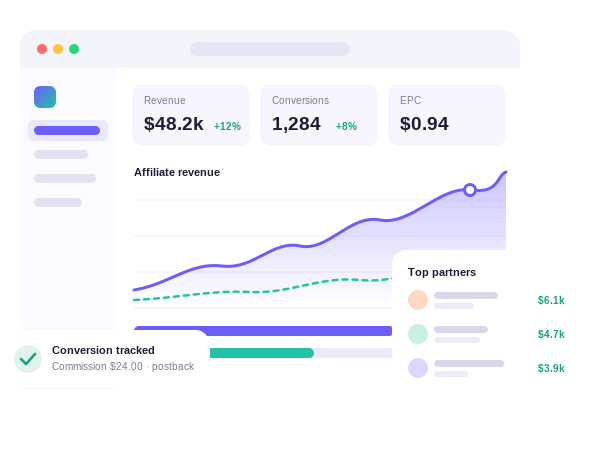
What counts as affiliate marketing software?
Affiliate marketing is a performance partnership: a merchant pays partners (affiliates, publishers, creators) a commission when the traffic they send turns into a sale, a lead or a signup. Software sits in the middle of that relationship. It records which partner sent which customer, applies the commission rules, and makes sure everyone gets paid correctly.
The term covers several different kinds of tools, and people often compare products that solve different problems. The four main groups are below.
Tracking platforms
Attribute clicks and conversions to partners using cookies, server-to-server postbacks and coupon codes.
Program management
For merchants running their own program: partner onboarding, commission rules, payouts, fraud checks.
Networks vs in-house
Join a network with a ready-made partner marketplace, or run a program on your own software.
Publisher tools
For affiliates: link cloaking, link health monitoring, comparison tables and earnings reporting.
How to choose in five steps
- Decide which side you're on. Merchants need tracking and program management. Publishers need link and reporting tools. Many buying mistakes come from mixing the two.
- Map how you sell. One-off purchases, subscriptions, leads and app installs each need different attribution and commission logic. Recurring commissions and refunds are where cheap tools usually fall short.
- Check tracking against privacy rules. Browser cookie restrictions keep tightening. Prefer tools that support first-party or server-side (postback) tracking and coupon attribution, not only third-party cookies.
- Count the full cost. Look past the monthly fee: transaction or revenue-share fees, payout fees, minimum contracts, overage charges, and the time your team spends on manual work.
- Test with real data. Run a trial with a few partners and a test order. Confirm the conversion shows up, refunds reverse the commission, and the payout file is correct.
The full evaluation checklist turns these steps into questions you can send to any vendor.
Frequently asked questions
Do I need dedicated affiliate software to start an affiliate program?
Not always. Very small programs can start with a network, a plugin for their store platform, or even coupon codes tracked by hand. Dedicated software becomes worth it once you have more than a handful of active partners, recurring commissions, or payouts that take real time each month.
What is the difference between an affiliate network and affiliate software?
A network is a marketplace that brings merchants and affiliates together and usually handles tracking and payouts for a fee. Affiliate software is a tool you license to run your own program, where you recruit partners yourself and keep the relationship.
How does affiliate tracking work without third-party cookies?
Modern platforms combine first-party cookies set on the merchant's own domain, server-to-server postbacks that pass a click ID from the landing page to the order, and non-cookie signals like unique coupon codes. Together they keep attribution working when browsers block third-party cookies.
How much does affiliate marketing software cost?
Pricing varies widely. Common models are a flat monthly subscription, a percentage of affiliate-driven revenue, a per-conversion fee, or a mix. Networks typically charge a setup fee plus a cut of each commission. Compare the total yearly cost at your expected volume, not just the starting price.
Last updated 2026-11-24